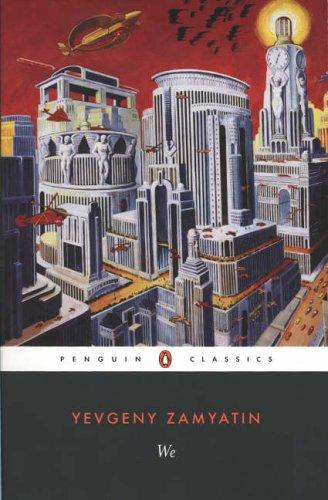
A donor brought in a box of Russian literature in translation last spring, mostly water-damaged, and this was the one paperback in decent shape. I’d been meaning to read it for years, mostly because I like knowing where a lineage starts, and 1984 owes this book more than most readers realize. Orwell reviewed it in 1946 and more or less admitted as much. The glass-walled apartments, the Single State, the Benefactor standing in for Big Brother, the numbered citizens instead of named ones: it’s all here first, written by a man who’d lived through the actual Bolshevik revolution and didn’t love what he saw coming next.
D-503 keeps a diary meant to be a hymn to the Single State’s rational perfection, a mathematician cataloging the beauty of a society that has eliminated privacy, ambiguity, and the letter I as anything but a component of We. The diary format is the smartest choice in the book, because it lets Zamyatin show the cracks in D-503’s reasoning in real time, the moment he meets I-330 and starts feeling things his mathematics has no vocabulary for. You watch a true believer’s prose style come apart sentence by sentence, which is a much harder thing to dramatize than a straightforward rebellion plot, and Zamyatin mostly pulls it off.
Mostly. I’ll be honest that the back half loses some of its footing. The romantic plot with I-330 never quite convinced me the way the ideological unraveling did, and there’s a stretch in the middle where D-503’s mounting paranoia repeats itself rather than escalating. A few reviewers I’ve seen argue the third-person distance a more conventional narrator might have provided would have served the plot better; I don’t think that’s right, since the entire point is that we’re trapped inside a consciousness losing its own logic, but I understand the frustration with a narrator this unreliable for this long.
Worth reading as the hinge text it is, not just for what it influenced but for what it’s actually arguing: that a perfectly rational society is not the same thing as a humane one, and that the difference shows up first in what the society can’t let its citizens feel. The translation I read (Natasha Randall’s) keeps a jagged, clipped rhythm in the entries that I suspect is doing real work matching Zamyatin’s original prose style, though I’d want to read a second translation side by side to be sure.