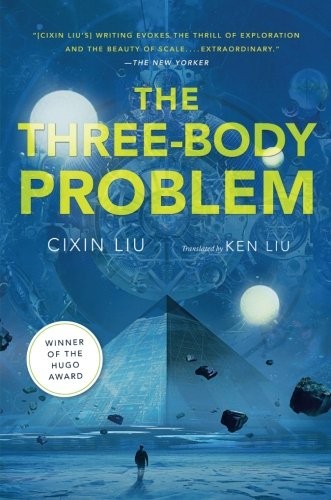
I bought this one three separate times before I actually read it. Customers kept trading it in, I kept shelving it, and it took a slow week in January for me to finally sit with a returned mass-market copy at the counter and start. I mention this because the book earns that kind of accidental patience. It does not open where you expect a first-contact novel to open. It opens in a Red Guard struggle session in 1967, and it stays there long enough that you start to wonder if the jacket copy lied to you about what kind of book this is.
It didn’t lie. That opening is the hinge the entire plot turns on, and Liu Cixin trusts you to sit in Ye Wenjie’s grief and disillusionment for as long as it takes to understand why she does what she eventually does with a very large radio telescope. The physics that follows, the game embedded inside the novel, the slow unspooling of what the Trisolarans actually are, all of it depends on that opening having been earned rather than skipped.
Ken Liu’s translation is the reason this reads as smoothly as it does in English, and I don’t say that as a throwaway credit line. He kept footnotes rather than smoothing over cultural specifics that an editor might have flattened for an American audience, and the prose has a plainness to it that I initially read as flat until I realized it was doing the same thing hard SF prose has always done: getting out of the way of the idea. There’s a rhythm to the sentences describing the sophon unfolding into higher dimensions that reads like it was built for that scene specifically, not translated into approximate English and left there.
I’ve read complaints, some from customers who’ve special-ordered the sequels, that the characters are thin next to the ideas. I don’t think that’s quite fair to Wang Miao, whose disorientation carries the middle section, but it’s also beside the point. This is a novel interested in civilizations and timescales, not psychology, and it’s honest about that interest from the first chapter to the last. The countdown embedded in Wang’s vision, the reveal of what it actually is, is one of the best pieces of tension I’ve read built entirely out of an idea rather than a threat to a specific person.
Winner of the Hugo, and it’s rare that award actually goes to the book that most changes how you think about the genre it’s in. This one did, for me. I’m finally getting to the sequels this year, whichever copy shows up on the trade-in table next.