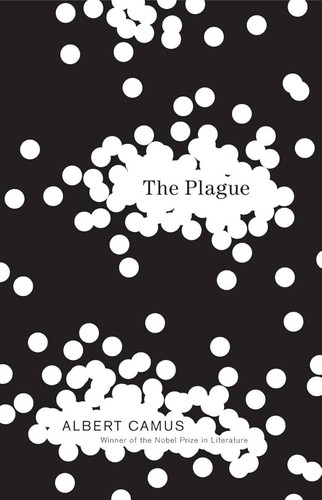
I keep a small shelf behind the register for books I reread on a cycle rather than lend out, and this has been on it since a customer’s donation box turned up a Stuart Gilbert translation with somebody’s careful pencil underlining running through the whole thing. I’ve since read the Laura Marris retranslation too, and the comparison sharpened something for me about how much a translator’s choices shape a book that already reads, on its surface, like plain reportage.
The trick of the novel is the narrator, revealed only at the very end to be Dr. Rieux, who has spent the entire book describing his own actions in the third person, as though refusing the intimacy of I even while performing an intensely personal, exhausting kind of care. That choice is doing philosophical work, not just formal work. Rieux’s heroism, if you want to call it that, is unglamorous and procedural: counting rat carcasses, filling out forms, injecting serum that mostly doesn’t work, showing up again the next day. Camus is arguing, through form as much as through Tarou’s explicit speeches about it, that decency under catastrophe looks like repetition, not transcendence.
Some readers come to this looking for a more emotionally immediate account and find the distance frustrating, and I understand the complaint, particularly around the female characters, who exist mostly offstage or as absences the male characters feel: Rieux’s wife recovering elsewhere, Rambert’s lover back in Paris. The book is not interested in giving them interiority, and that’s a real limitation, not an oversight I’d wave away.
But the philosophical scaffolding, the running argument between Rieux’s practical humanism and Father Paneloux’s theology of collective punishment, and later Tarrou’s confession about what it means to try never to be “on the side of the pestilence,” gives the plainness of the prose somewhere to go. The final image, Rieux knowing the plague bacillus never dies for good, just waits, has only gotten sharper to me on each rereading, particularly the reading I did during a stretch a few years back when the whole city felt like it was holding its breath the same way. Bleak, exact, and I think one of the two or three best novels written about what ordinary people actually do during a catastrophe, which is mostly just keep working.