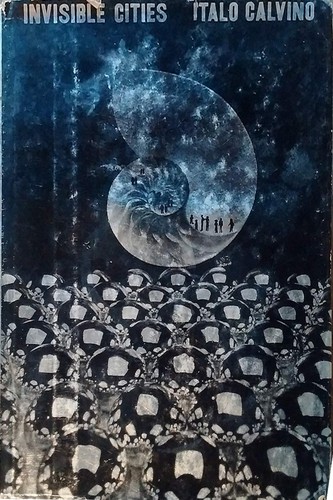
There’s no plot to speak of, which is the first thing I tell anyone before I hand this across the counter, because expecting a story is the fastest way to be disappointed by it. Marco Polo describes cities to an aging Kublai Khan, cities of memory, desire, signs, the dead, the sky, and each description runs two or three pages before the book moves on to the next one, occasionally interrupted by a short italicized dialogue between the two men about what any of this actually means. By the end you understand, or you’re told outright, that every city Marco has described is really Venice, described from a different angle each time.
William Weaver’s translation is the one nearly every English reader knows, and it earns that status. Calvino’s Italian has a crystalline, almost mathematical precision to the prose even while the imagery is at its most fantastical, cities built on stilts over a void, cities where the dead build a mirror version of the city of the living, and Weaver keeps that precision without letting it go dry. I’ve read a page or two of the Italian aloud with a customer who studied it and even without fluency you can hear the rhythm Weaver was working to preserve.
What holds the book together for me isn’t any single city description, though a few (Zaira, built entirely out of its relationships between measurements and memories; Zenobia, a city that exists purely as a structural response to the desires it can’t fulfill) have stayed with me for years. It’s the accumulating argument across all fifty-five: that a city is never really a place, it’s a structure of memory, desire, and language layered over a place, and every description of a city is really a description of the person doing the describing.
I’ve watched this book fail with readers who wanted momentum and want them to have that expectation going in rather than being blindsided by its absence. But for the reader willing to take it a few cities at a time, which I think is honestly the right way to read it, in short sittings rather than one long one, it rewards more than almost anything else this short on this shelf. One of maybe three books I own in two different translations just so I can compare them on a slow afternoon.