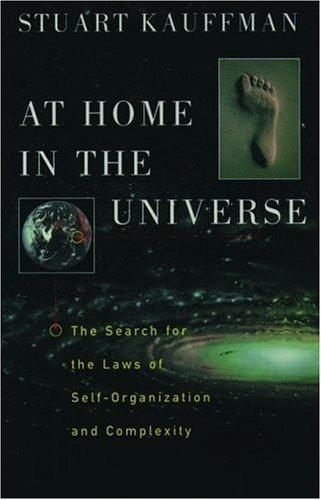
I don’t stock much theoretical biology at the shop, so this one came home with me rather than going on a shelf, after a customer who teaches at Brown mentioned it in passing while I was appraising his late colleague’s collection. Kauffman’s core claim is a genuine correction to a story most of us absorbed secondhand: that natural selection is the sole author of biological complexity. His argument, built out of his work on random Boolean networks, is that certain kinds of order emerge spontaneously from complex systems regardless of selection pressure, that the universe is, in his phrase, tilted toward self-organization, and evolution is working with that tilt rather than building order out of nothing.
The autocatalytic set material, chemical reaction networks that become self-sustaining once they cross a certain complexity threshold, is the strongest stretch in the book, and it’s genuinely exciting to read even without a chemistry background, because Kauffman explains the phase transition with real clarity. There’s a section on the NK fitness landscape model, tuning a dial between order and chaos to find the “edge of chaos” where complex adaptive systems seem to cluster, that I went back and reread twice, once for the concept and once just to enjoy how confidently he lays it out.
Where the book strains is in its back half, when Kauffman starts reaching from cellular biology toward economics, culture, and eventually a kind of general theory of everything complex, and the evidence gets thinner exactly as the claims get larger. I don’t doubt his instincts, but the prose in that stretch tips from patient explanation into something closer to evangelism, and a few other readers I’ve talked with about this book land in the same place: convinced by the biology, less convinced once he leaves it.
Still, the central corrective is worth the whole book on its own, and it’s close to what I was already circling a few months earlier when I wrote about The Overstory, oddly enough, since Powers’s ecological patience and Kauffman’s insistence that order can emerge without a designer or a competition to drive it are arguing something adjacent from very different directions. Dense in places and a little overreaching by the end, but a book that actually shifted how I think about where complexity comes from, which is not a small thing for four hundred pages of theoretical biology to do.