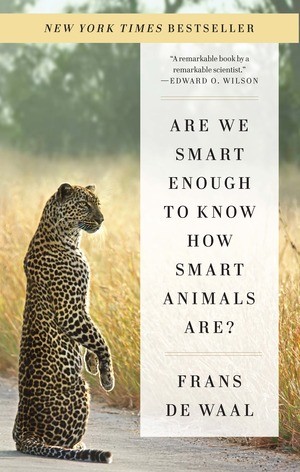
This is the rare nonfiction title I bought for myself rather than inherited from a donation box, on the recommendation of a regular customer who does something with fisheries research at URI. De Waal’s actual argument isn’t the one the title implies. He’s not really asking whether animals are smart. He’s asking whether the tests we’ve designed to measure animal cognition are honest, and the answer, again and again across the book, is that they mostly aren’t. A test built for a human hand doesn’t tell you anything useful about an elephant’s intelligence, it just tells you the elephant doesn’t have hands.
The mirror self-recognition chapter is the best example and the one I’ve retold at the counter more than once. For years, elephants failed the classic mirror test, and researchers took that as evidence they lacked self-awareness. Then someone built a mirror actually sized for an elephant, and the failure disappeared. That single anecdote does more to make de Waal’s case than any amount of argument could, because it’s not really a story about elephants, it’s a story about the limits of the people designing the test.
De Waal writes from decades inside primatology, and the chimpanzee and bonobo material is where his authority is most obvious, tool use, deception, reconciliation behavior after conflict, the kind of social cognition that took researchers a long time to admit they were seeing because admitting it meant giving up a comfortable line between human minds and everything else. He’s less rigorous, I’ll say, when the book wanders into corvids and cephalopods, where the citations start to feel secondhand rather than field-earned, and a reader looking for the same depth there will come away wanting more.
Structurally it’s a bit of a magpie’s nest itself, anecdote after anecdote loosely organized by theme rather than argument, and a stricter editor might have tightened the back third. But the anecdotes are good enough, and the through-line clear enough, that I didn’t mind the looseness. It’s a corrective book more than a comprehensive one, and it does that job well: I don’t think about animal cognition the same way after reading it, mostly because I don’t trust the old tests anymore.