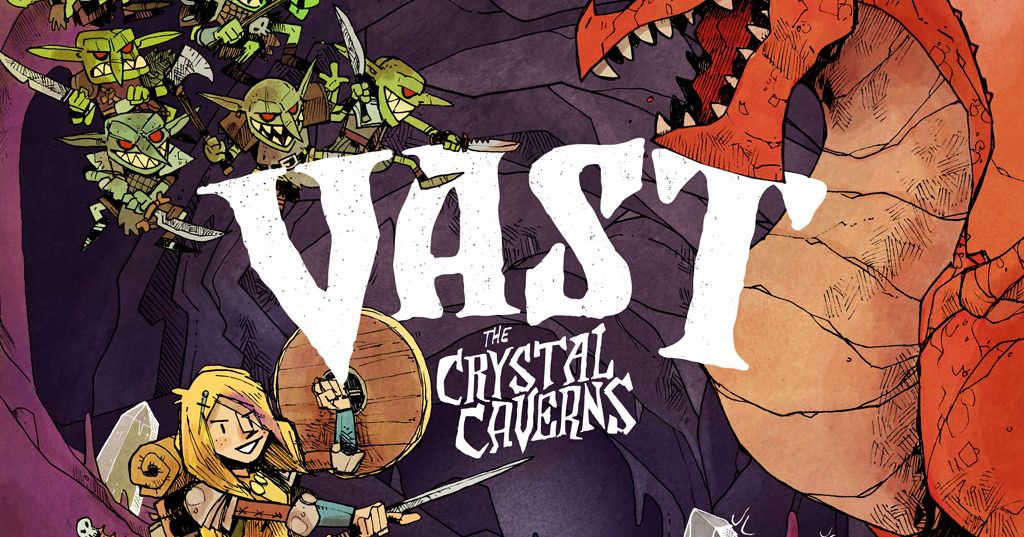
This is the asymmetric game I recommend most cautiously, because the pitch, every player controls a different role (the Cave, a lone Knight, the Goblins, a rampaging Dragon, or a trapped, wandering Thief) each with entirely separate victory conditions and rules, sounds like a nightmare to teach until you actually sit down and teach it. In practice, because each player only needs to learn their own role in depth and a rough sense of what everyone else is trying to do, the teaching burden splits up rather than stacking on one overwhelmed new player the way most asymmetric games do.
I played the Cave first, which might be the strangest role in modern board gaming: you’re not a character on the board so much as the board itself, placing tiles and hazards to hinder the Dragon specifically while everyone else pursues unrelated goals around you. It took me a full game to understand what the Cave was actually optimizing for, and a second game before I felt like I was playing it well rather than just reacting. That’s a real learning curve, and it’s steeper than most cooperative or competitive games I’ve reviewed here, because each role’s learning curve is independent of the others.
The rulebook has to solve a genuinely hard organizational problem, since it can’t teach the game linearly the way a normal rulebook does. Vast handles this by giving each role its own dedicated booklet rather than cramming everything into one shared document, which I appreciated on reflection even though it initially felt fragmented, five separate slim manuals rather than one thick one. It means new players can focus entirely on their own role’s booklet during setup without wading through four other rulesets they don’t need yet, though it also means nobody at the table has the full picture, which occasionally leads to arguments about interactions that require flipping through someone else’s booklet mid-game.
Component quality is solid without being showy, and the dragon miniature is a nice centerpiece even if the rest of the pieces are fairly standard wooden meeples and cardboard tiles. The real achievement here is structural: five genuinely different games sharing one board and one clock, somehow balanced against each other well enough that no single role feels like the obvious best pick. Worth the teaching investment if your group is patient with a first, slightly confused session.